Loading Docks Are Where Trucks, Forklifts and People Meet: A Flagman Control Plan for Australian Warehouses
Loading dock safety in Australian warehouses: how separation, driver safe zones and Flagman forklift pedestrian detection reduce collisions between trucks, forklifts and people at the dock.
In brief
- The problem: the loading dock is where heavy vehicles, forklifts, delivery drivers and warehouse staff share the least space, under the most time pressure.
- The requirement: Australian regulators expect separation first, with designated safe zones for drivers, dedicated loading areas and a traffic management plan for the warehouse.
- The solution: Flagman AI detection watches the dock apron and bay doors, warns forklift operators when a person is close, and logs every interaction as time-stamped video.
- The outcome: fewer unseen near misses, faster correction of drift from the plan, and evidence your board and regulator can review.
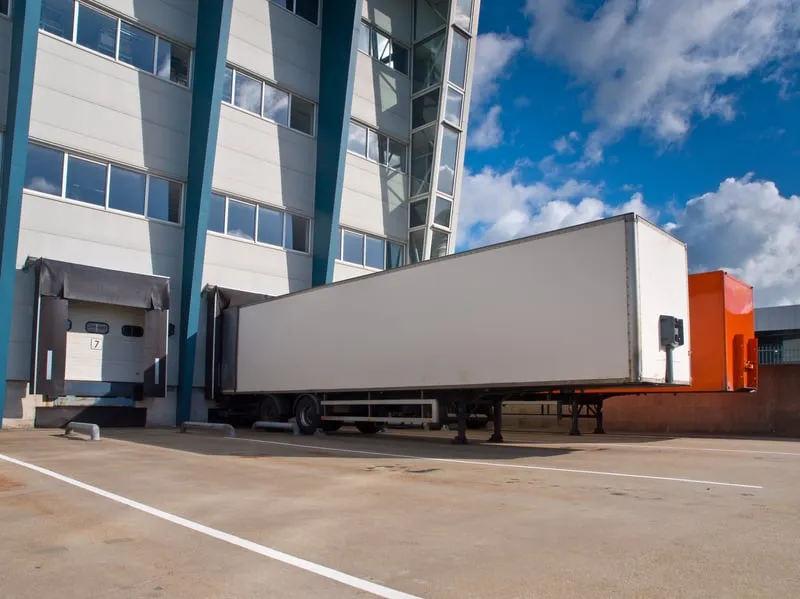
It is 5.40 am and three trucks are backed onto the dock at once. One driver has stepped out of his cab to check paperwork. A forklift operator is reversing out of a trailer with a full pallet, looking over his shoulder at the dock edge. A team leader walks across the bay to chase a missing delivery note.
Nobody in that scene is doing anything unusual. That is the problem. Loading dock safety fails quietly, in routine moments, and most close calls are never recorded.
The problem: the dock concentrates vehicle risk
Vehicles dominate serious harm at Australian workplaces. Safe Work Australia reports 188 worker fatalities in 2024, and at least one vehicle was involved in 66 per cent of them (124 deaths). Being hit by moving objects caused 17 fatalities and around 23,400 serious claims in 2023 to 2024.
The transport, postal and warehousing industry carries a heavy share. It recorded 54 worker fatalities in 2024, a rate of 7.4 per 100,000 workers, and around 10,400 serious claims in 2023 to 2024.
Forklift and pedestrian contact is a large part of that picture. WorkSafe Victoria reports eight forklift-related deaths in Victoria since 2019, including three pedestrians working near forklifts. In one year, 65 of 157 accepted forklift-injury claims in Victoria involved pedestrians.
The dock adds hazards of its own. WorkSafe WA notes that loading docks are typically 1.2 metres above ground, so a forklift wheel over the edge can injure the operator and anyone nearby. Trucks can also move away before loading is complete, which Safe Work Australia’s warehousing guide describes as the risk of “inadvertent drive-offs”.
The cost of getting it wrong is real. In October 2025, a Perth court fined Toll Transport $625,000 after a worker changing floor markings in freight bays was struck from behind by a reversing forklift in 2021. The business had a three-metre exclusion zone in its procedures, but the court found forklifts and pedestrians should have been separated, and WorkSafe WA said barricades were practicable.
The requirement: what Australian regulators expect at the dock
Under the model WHS laws, a business must eliminate risks so far as is reasonably practicable, and minimise those it cannot eliminate using the hierarchy of controls. In Victoria, the same duty sits under the Occupational Health and Safety Act 2004. Dock-specific guidance from the regulators is consistent:
- Separate first. Safe Work Australia’s Traffic Management Guide for Warehousing says eliminating the risk by separating vehicles and pedestrians should be considered first, with barriers, engineering controls, speed limits and signage next.
- Keep drivers out of the loading area. The same guide says operators should not load or unload unless workers and drivers are clear, and that drivers should have a designated safety zone to wait in. SafeWork NSW’s Forklift Safety Guide for Employers says to provide dedicated loading and unloading areas and, wherever possible, prevent delivery drivers entering the loading area.
- Protect the dock edge. WorkSafe WA refers to Australian Standard 2359.2, which calls for physical barriers or other appropriate systems where a forklift wheel could be driven over a dock edge.
- Consider proximity technology. WorkSafe Victoria’s forklift guidance suggests employers consider proximity devices that detect pedestrians and slow mobile plant. SafeWork NSW lists forklift-to-worker proximity sensors and speed-limiting devices among the safety devices employers can retrofit.
Together these form the core of a traffic management plan for a warehouse dock, and a large part of practical WHS compliance for any distribution centre.
Why existing controls leave a gap
Most sites already have painted walkways, signs, a driver waiting room and a rule that drivers stay in the safe zone. Those controls work when everyone follows them. The gap is what happens when they do not.
- A pedestrian exclusion zone marked on the floor does not tell anyone when it has been entered.
- Mirrors and reversing beepers rely on the operator looking and the pedestrian listening, at a time when both are busy.
- Supervisors cannot watch every bay on every shift, and early starts often have the thinnest supervision.
- Near misses at the dock are rarely reported, so the plan is reviewed against incidents rather than against what really happens.
The solution: how Flagman strengthens loading dock safety
Flagman uses AI vision to detect people, vehicles and personal protective equipment in camera footage, and processes that footage on site at the edge. It does not need a cloud or internet connection. It works with ONVIF IP cameras, so many sites can start with AI on existing CCTV that already covers the dock apron.
At the dock, Flagman can support these controls:
- Forklift pedestrian detection. Forklift-mounted or fixed cameras detect a person near the forklift. In a typical setup, a warning is raised at about 2.5 metres and a critical alert at about 1.5 metres. Where the forklift’s controls accept an external signal, mainly on electric units, Flagman can send a slow or stop signal.
- Driver safe zone monitoring. A virtual zone over the loading area triggers an alert when a person enters it while a forklift is working, so the rule that drivers stay clear becomes visible in real time.
- Bay and crossing signals. Relay outputs and programmable logic controller integration over Modbus and PROFINET can drive warning lights or signals at bay doors and pedestrian crossings when people or vehicles are detected.
- Time-stamped evidence. Every event is logged with video to a central dashboard, so safety teams can review near misses by bay, shift and time of day.
The aim is not to watch people. It is to tell an operator, at the point of risk, that someone is there.
Limitations: what Flagman does not do
- Flagman does not replace separation, barriers, dock edge protection, wheel chocks, vehicle restraints or a documented traffic management plan. It adds a detection layer on top of them.
- Flagman has no published Safety Integrity Level or Performance Level rating. Its slow or stop output is not a certified safety function, and it is not a presence sensing safeguarding device.
- Detection depends on camera position, lighting, weather and line of sight. Each bay needs a site assessment and testing before you rely on the alerts.
- Camera monitoring at work is regulated. In New South Wales, the Workplace Surveillance Act 2005 requires written notice to workers before monitoring starts. Consult workers, use signs, and keep audio off by default.
A practical loading dock control plan
- Map every movement at the dock: trucks arriving and reversing, forklifts entering trailers, drivers, and staff crossing bays.
- Apply separation first: dedicated loading areas, physical barriers, a marked driver safe zone and edge protection on every raised dock.
- Write or update the traffic management plan for the warehouse, including how drivers are briefed when they arrive.
- Identify the residual gaps: blind spots at bay doors, trailer exits and crossing points.
- Place Flagman detection on those gaps, using existing cameras where coverage is good enough.
- Consult workers and health and safety representatives before switching on, and give the notice your state requires.
- Tune alert zones for two to four weeks so operators trust every alert.
- Review event data monthly and feed it back into the plan.
Dock equipment is a safety control: the case for predictive maintenance
Dock levellers, vehicle restraints, bay doors, warning lights and forklift brakes all wear out between inspections. When one fails at 5.40 am, the safe system of work fails with it. Most warehouses still repair dock equipment after a breakdown or on a fixed calendar. A predictive approach uses pre-start defects, fault logs and repair history to find the bay or forklift that is drifting towards failure before it causes harm.
Sharktech Global builds Business Intelligence dashboards for warehouses that connect warehouse management, enterprise resource planning and operational data, and can add Flagman safety events. A bay with recurring leveller faults and rising pedestrian alerts is a bay that needs attention this week, not after an incident.
Flagman in Australia: local delivery by Sharktech Global
Sharktech Global, based in Liverpool, New South Wales, is the exclusive Australian and New Zealand delivery partner for Perleybrook Labs, the developer of Flagman. It assesses docks and warehouses, installs and integrates Flagman with cameras and plant controls, and provides local business-hours support, alongside managed IT for scanners, label printers and rugged tablets. Details of its warehouse safety, managed IT and data services are on the Sharktech website.
The outcome you can measure
- Alerts delivered to forklift operators at the moment a person is close, not after an incident.
- Near misses at the dock captured as data, by bay, shift and time of day.
- A baseline of interactions in the first month, then a comparison as separation and procedures improve.
- Dock equipment faults visible alongside safety events, supporting earlier maintenance decisions.
- Video evidence of how controls perform, ready for board reporting and regulator conversations.
For more on separating forklifts and people across the whole site, read our warehouse traffic management plan guide. If you are comparing technologies, see our scorecard for choosing a pedestrian detection system.
Key takeaways
- Loading dock safety starts with separation, driver safe zones and edge protection.
- Regulators in Victoria and New South Wales point employers to proximity technology as an added control.
- Flagman forklift pedestrian detection adds warnings and evidence at the dock without replacing physical controls.
- Measure interactions, near misses and equipment faults so your traffic management plan improves on real data.
Next step
Request a Flagman safety assessment to map the interaction points at your dock, or call Sharktech Global on 0468 017 373.
Sources: Safe Work Australia, Key WHS Statistics Australia 2025; Safe Work Australia, Traffic Management: Guide for Warehousing; SafeWork NSW, Forklift Safety: Guide for Employers; WorkSafe Victoria, New guidance and inspections target forklift safety (22 May 2024); WorkSafe WA, Forklifts and loading docks; WorkSafe WA, Transport company fined $625,000 over worker injury. This article is general information only and is not legal advice. Seek advice specific to your site and jurisdiction.