Forklift Pedestrian Injuries in Distribution Centres: A Traffic Management Plan Backed by Flagman Proximity Detection
Forklifts seriously injure more than one Victorian worker every week. A practical guide to warehouse traffic management, pedestrian exclusion and proximity detection for Australian distribution centres.
In brief
- Forklifts remain one of the biggest sources of serious injury in Australian warehouses. In Victoria alone, more than one worker every week is seriously injured after being struck by a forklift or a falling load.
- Regulators expect distribution centres to separate pedestrians from forklifts with physical barriers, exclusion zones and a traffic management plan that reflects how the floor actually operates.
- WorkSafe Victoria now encourages businesses to consider proximity devices that detect pedestrians and slow mobile plant, alongside separation.
- The most effective warehouses treat traffic management as a living system: designed into the layout, checked every shift and measured with real data.
More than one Victorian worker every week is seriously injured after being struck by a forklift or a falling load.
WorkSafe Victoria, May 2024
A modern distribution centre is a moving system. Inbound trucks arrive on tight windows, pickers chase order cut-offs, reach trucks work high bays, and contractors, drivers and visitors pass through all day. In that environment, the gap between a well-designed traffic plan and what actually happens on the floor can open within weeks.
This guide sets out what Australian regulators expect, the controls that make the biggest difference, and how detection technology can support a traffic management system without replacing the fundamentals.
The risk in numbers
WorkSafe Victoria reports that eight people have been killed in forklift-related workplace incidents in the state since 2019, including three pedestrians working near forklifts. In the year before its 2024 forklift campaign, pedestrians accounted for 65 of the 157 accepted claims where a forklift incident caused the injury. On average, more than one Victorian worker every week is seriously injured after being struck by a forklift or a falling load.
Nationally, Safe Work Australia reports that at least one vehicle was involved in 66% of worker deaths in 2024. Forklifts are not the only vehicles in that figure, but in warehousing and logistics they are the vehicles workers encounter most often.
What regulators expect
Under the model Work Health and Safety Regulations, which apply in most states and territories, regulation 215 requires controls so that powered mobile plant does not collide with pedestrians, and a warning device where a collision risk exists. Regulation 36 requires controls to be chosen in order, with elimination and engineering controls ahead of procedures and personal protective equipment. Victoria applies similar duties under the Occupational Health and Safety Act 2004.
WorkSafe Victoria’s Forklift Safety Guidebook, released with a state-wide inspection program in May 2024, gives a practical picture of what inspectors look for:
- physical separation of forklifts and people on the ground, using barriers, exclusion zones and signage
- a traffic management system that controls how forklifts move around workers
- consideration of retrofitted technology, such as sequential seatbelt interlocks and proximity devices that detect pedestrians and slow mobile plant
Building a traffic management plan that works on the floor
Many warehouse traffic plans look good in a folder and fail on the floor. The plans that work share five features.
1. They start with the layout
Map every route a forklift takes and every route a person takes, including pickers, maintenance staff, truck drivers and visitors. Where the two cross, decide whether the crossing can be removed, moved or controlled. Pedestrian walkways should be physically protected, not just painted, wherever forklifts operate at speed or carry loads that block visibility.
2. They create true exclusion zones
Racking aisles under active forklift operation, loading docks and battery charging areas should be no-go zones for pedestrians while forklifts are working. Physical gates, interlocked where practical, are far more reliable than signs.
3. They control the high-risk moments
Most serious incidents happen at predictable points: reversing out of aisles, turning at blind corners, loading and unloading trucks, and shift changes when traffic peaks. Speed limits, convex mirrors, one-way systems and controlled crossing points should target these moments specifically.
4. They cover everyone on site
Truck drivers waiting during loading and visitors walking to offices are often the least familiar with site rules. Designated safe waiting areas and escorted access matter as much as operator training.
5. They are checked and measured
A traffic plan is only as good as its last review. Supervisors should walk the floor regularly, near misses should be recorded rather than shrugged off, and the plan should be updated whenever racking, layout or volumes change.
The solution: Flagman proximity detection on the warehouse floor
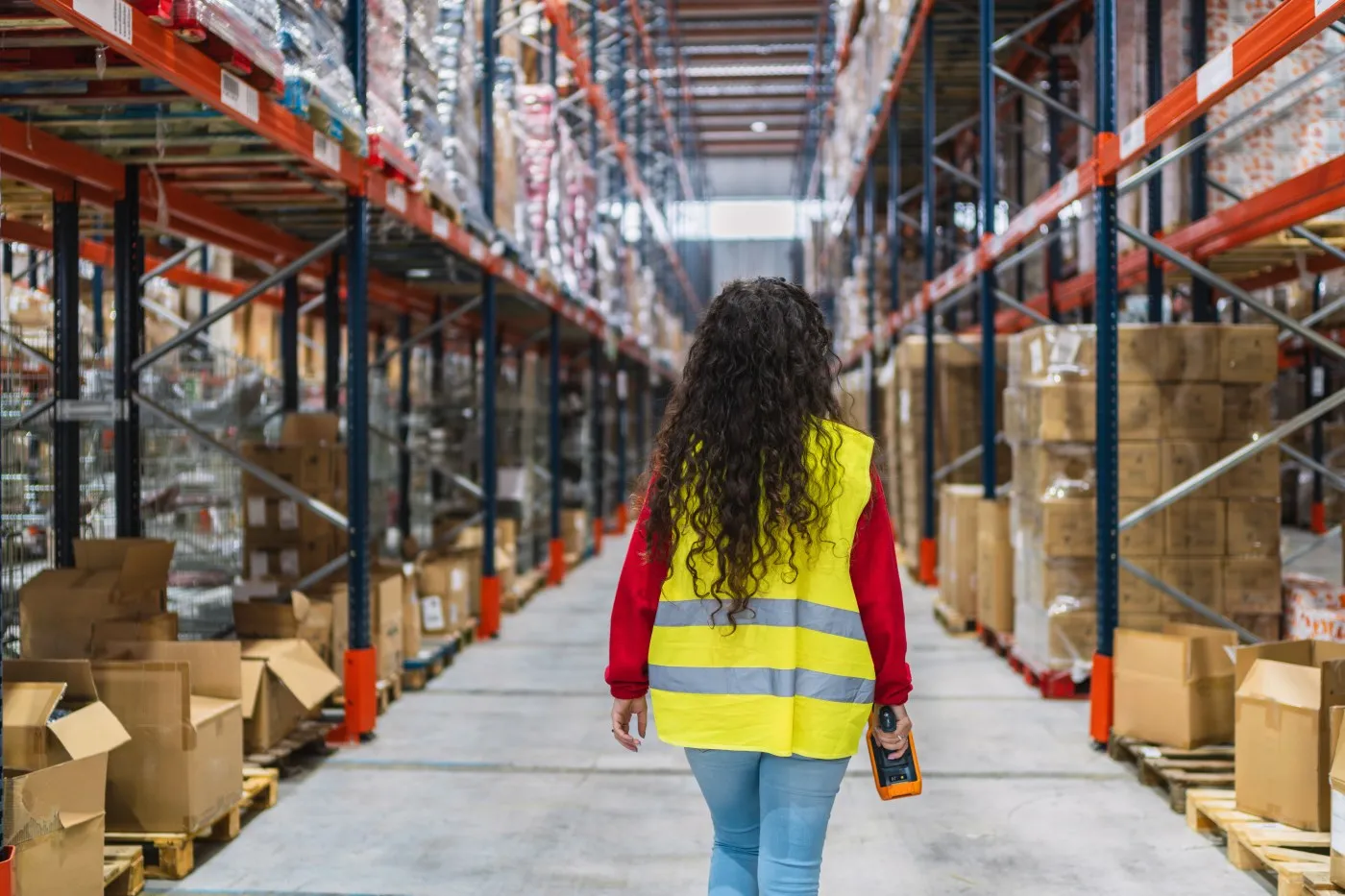
Even with good separation, forklifts and people still share space in most warehouses. This is where proximity and pedestrian detection adds value. It gives the operator a warning they cannot get from mirrors alone, at the moment it matters.
There are several types of system on the market, including tag-based systems worn by pedestrians, radar, and camera-based AI. Camera-based AI systems such as Flagman use cameras on the forklift to watch blind spots, recognise people in real time and trigger audible and visual alerts. On forklifts whose controls accept an external signal, mainly modern electric models, the system can also slow or stop the truck. Because the analysis runs on a device fitted to the forklift, it keeps working without an internet connection.
Camera-based detection has a practical advantage in busy distribution centres: it does not rely on every person carrying a tag, which matters when contractors, drivers and visitors are on the floor. Its limits are just as important to understand. Cameras need a clear view, lenses must be kept clean, zones must be tuned to avoid nuisance alarms, and any automatic slowing or stopping function needs proper engineering assessment on each truck before it is relied on.
Turning near misses into data
One of the most underrated benefits of detection technology is the data it produces. Every alert is a record of a moment when a person and a forklift came too close. Over weeks, those records reveal patterns: the aisle where pickers cut through, the dock where drivers wait in the wrong place, the shift change that creates congestion.
That information allows safety teams to fix the layout or process at the source, which is exactly what the hierarchy of controls asks for. Used this way, detection does not just warn operators. It shows managers where the traffic plan needs to change.
A 30-day starting plan for distribution centres
- Week one: map all forklift and pedestrian routes and mark every interaction point on a floor plan.
- Week two: record every near miss and close call, and observe the high-risk moments at each shift change.
- Week three: fix the quick wins: protected walkways, gates at aisle ends, safe waiting areas for drivers and clear signage.
- Week four: review the remaining interaction points and decide where detection technology would reduce risk most, starting with the busiest trucks and zones.
The outcome you can measure
Distribution centres that combine a strong traffic plan with Flagman can expect clear, measurable outcomes: operators warned before contact in the places mirrors cannot cover, near misses captured automatically instead of lost, and a heat map of where pedestrians and forklifts interact most. Over time, that data shows whether new walkways, gates and crossing points are actually reducing interactions, and gives the business evidence that it is acting on the hierarchy of controls and on WorkSafe guidance.
Key takeaways
Separation remains the foundation of forklift safety in Australian warehouses. A traffic management plan that is designed into the layout, enforced at the high-risk moments and reviewed with real data will prevent more incidents than any single product. Proximity detection, which regulators now actively encourage businesses to consider, then closes the gap where people and forklifts must still share space.
Next step
If you manage a warehouse or distribution centre, a site safety assessment is the quickest way to see where people and forklifts still interact. Request a Flagman safety assessment. In Australia, Flagman is delivered and supported locally by Sharktech Global.
Sources: WorkSafe Victoria, New guidance, inspections target forklift safety (May 2024); Safe Work Australia, Key Work Health and Safety Statistics Australia 2025; model Work Health and Safety Regulations 2011, regulations 36 and 215. This article is general information, not legal or safety advice for your site.