Cold Store Safety in NSW Warehouses: How Flagman Adds Detection Where Freezer Doors, Forklifts and Lone Workers Meet
Cold store safety in NSW warehouses: what SafeWork NSW expects for freezers, forklifts and lone workers, and where Flagman detection and people counting add an early warning.
In brief
- Cold stores combine forklifts, poor visibility, slippery floors, noise and people working alone, in a space where a trapped worker can be in danger within minutes.
- SafeWork NSW expects businesses to plan for cold stress, entrapment, lighting, slips, noise and hazardous atmospheres, and to keep constant observation or a buddy system for workers in cold rooms and freezers.
- Separation, safe doors, internal release mechanisms and alarms come first. Flagman AI detection can add forklift and pedestrian warnings at freezer doors and count who has gone in and who has come out.
- The outcome to aim for: no one left inside at lock-up, fewer surprises at door transitions, and a record of what happens in the cold zone.
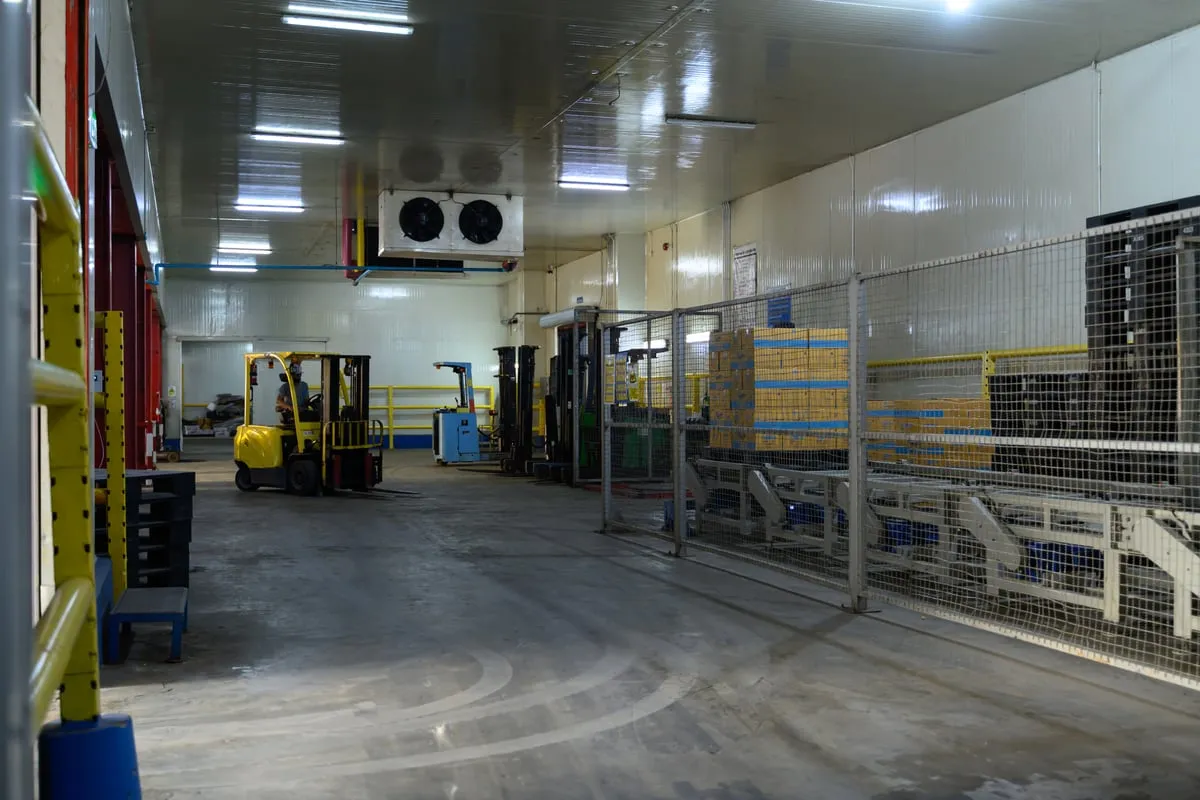
It is 2:40 in the morning at a chilled distribution centre in western Sydney. A picker walks through the strip curtain into the freezer to grab one last carton. A reach truck is coming the other way. The driver’s view is part fog, part plastic curtain, and the picker is in dark thermal clothing. The refrigeration fans drown out the horn.
Nobody is hurt, and nobody reports it. Ten minutes later the shift lead walks the freezer before closing the door, relying on memory to know whether anyone is still inside. That is cold store safety in many warehouses: high-risk work with very little data about what happens behind the curtain.
The problem: cold stores stack several hazards in one room
Vehicles are involved in most work deaths in Australia. Safe Work Australia reports 188 worker fatalities in 2024, and at least one vehicle was involved in 66% of them. In New South Wales, SafeWork NSW ran a statewide compliance operation on mobile plant, fixed machinery and vehicles in 2025. By 14 March 2025 inspectors had issued more than 140 notices, and most related to forklift safety, including separation from pedestrians.
Cold stores add to that forklift risk. SafeWork NSW lists the hazards of cold environments as cold stress, hypothermia and frostbite, reduced coordination, compromised lighting, noise from refrigeration plant, slips from ice and condensation, entrapment in cool rooms or freezers, and poor ventilation that can let forklift fumes or a refrigerant ammonia leak build up. SafeWork SA names the same core hazards for walk-in coldrooms and freezers, and adds working in isolation. WorkSafe Victoria’s cold storage handbook states that hundreds of people are injured each year while working in cold storage facilities.
The requirement: what NSW regulators expect
Under the Work Health and Safety Act 2011 (NSW), a person conducting a business or undertaking must eliminate risks so far as is reasonably practicable, or minimise them using the hierarchy of controls. For cold stores, SafeWork NSW guidance sets out practical expectations:
- Schedule and pace work to the conditions, with acclimatisation for new workers, job rotation and regular rest breaks.
- Train workers to recognise hypothermia symptoms in themselves and others.
- Ensure constant observation by a supervisor or a buddy system, and reliable communication for remote or isolated workers.
- Provide doors that prevent people being trapped, and keep regular contact with workers entering cold environments.
- Provide lighting that allows safe movement and appropriate detection and ventilation for fumes and ammonia.
SafeWork SA adds specific controls that NSW sites can adopt: keep internal door opening mechanisms maintained and tested, fit and test emergency alarm buttons, and do not rely on mobile phones inside coldrooms, because they may not work and batteries can freeze. Forklift interaction is managed under the same plant duties as the rest of the warehouse, set out in the SafeWork NSW Code of Practice for managing the risks of plant in the workplace.
Why existing controls leave a gap
Most cold stores have the right paperwork: a traffic management plan, a buddy rule, a door check before lock-up. But these controls depend on people remembering them at the end of a long, cold shift.
- Buddy systems break down when one worker is pulled to another task.
- Lock-up checks rely on a visual walk through racking in low light and fog.
- Strip curtains and rapid roll doors block sight lines at exactly the point where forklifts and pickers cross.
- Near misses at the freezer door are rarely reported, so there is no baseline to improve against.
The solution: how Flagman supports cold store safety
Flagman uses AI vision on site cameras to detect people and vehicles and to raise alerts at the point of risk. In a cold store, it can be applied in three practical ways.
Forklift and pedestrian detection at door transitions. Detection zones can be set on both sides of freezer doors and curtains. In a typical forklift setup, Flagman raises a warning at about 2.5 metres and a critical alert at about 1.5 metres. Where the forklift’s controls accept an external signal, Flagman can send a slow or stop signal. Lights and sounders can be chosen to suit a noisy refrigerated space. For broader aisle controls, see our guide to narrow aisle forklift safety for order pickers and reach trucks.
People counting at freezer entries. Flagman’s people counting records entries and exits at a defined door. At lock-up, a count that does not reconcile tells the shift lead to check again before the door is closed. It also shows how long people spend inside, which helps supervisors manage exposure time and rotations.
After-hours alerts. A person detected in the freezer outside planned work times can trigger a supervisor alert, supporting existing lone worker procedures.
Processing happens on site at the edge, so the system does not need cloud or internet access. Every alert is stored as a time-stamped video event, which turns door-zone near misses into reviewable safety data.
Predictive maintenance: plant condition is part of the hazard
In a cold store, equipment condition and worker safety are closely linked. A worn freezer door seal lets moist air in and builds ice on the floor at the threshold. A slow or faulty rapid roll door holds forklifts and pickers in the same space for longer. An internal release handle or alarm button that has not been tested may fail when it matters. Forklift batteries and brakes behave differently in sustained cold, and refrigeration plant faults can affect both temperature and air quality.
Maintenance and downtime records can show where these failures are building before someone is hurt. Sharktech Global builds Business Intelligence dashboards that bring maintenance, downtime and safety data together, including Flagman events. A site can then see, for example, whether near-miss alerts at a freezer door rise when that door’s fault tickets rise, and prioritise the repair.
Limitations: what Flagman cannot do
- Flagman does not replace safe door design, internal release mechanisms, emergency alarms, separation or the buddy system. It strengthens them.
- Flagman is not a gas detector. Ammonia and forklift fume risks need dedicated detection and ventilation.
- Flagman does not monitor body temperature, cold stress or fatigue, and it does not provide in-cab fatigue detection.
- Camera placement matters. Fog, condensation and low light can reduce detection, so every site needs a trial in its own conditions. Flagman Neo hardware is rated from minus 20 to plus 80 degrees Celsius, so blast freezers colder than that need cameras positioned outside the coldest zone or another approved enclosure.
- Slow or stop outputs only work where the forklift accepts an external signal, and they are not a certified safety function.
- Cameras in a workplace bring surveillance law duties. In New South Wales, the Workplace Surveillance Act 2005 requires written notice before surveillance starts.
A practical plan for cold store safety
- Map every cold room, freezer and blast freezer, its doors, and the forklift and pedestrian routes through them.
- Test every internal release mechanism and alarm button, and record the results.
- Consult workers about where near misses, slips and door delays happen.
- Apply higher order controls first: separate pedestrian doors where possible, improve lighting, and fix door and floor defects.
- Trial Flagman at the highest-risk door, with forklift detection on both sides and people counting at the entry.
- Review Flagman events and maintenance data monthly and update the traffic management plan. Our peak season warehouse traffic management plan shows how to keep that plan current as staffing changes.
The outcome you can measure
- A reconciled entry and exit count at every lock-up.
- A visual and audible warning at freezer doors that does not rely on a driver seeing through fog.
- A baseline of door-zone near misses, compared before and after new controls.
- Evidence for boards, workers and SafeWork NSW that cold store controls are working, not just written down.
Flagman in Australia: local delivery by Sharktech Global
Sharktech Global, based in Liverpool, New South Wales, is the exclusive Australian and New Zealand delivery partner for Perleybrook Labs, the designer and manufacturer of Flagman. Sharktech Global assesses sites, installs and integrates Flagman with existing cameras and site systems, and provides local support during business hours. Learn more about warehouse technology and AI safety from Sharktech Global.
Key takeaways
- Cold stores combine forklift, cold stress, entrapment, slip and isolation hazards in one space.
- SafeWork NSW expects planned work, trained workers, constant observation, safe doors and adequate lighting and ventilation.
- Flagman adds forklift warnings at door transitions, people counting at freezer entries and time-stamped evidence.
Next step
Request a Flagman safety assessment or call Sharktech Global on 0468 017 373.
Sources: SafeWork NSW, Working in cold environments; SafeWork SA, Cold storage facilities; WorkSafe Victoria, Safe operation of cold storage facilities: A handbook for workplaces; SafeWork NSW, Statewide SafeWork Op, 14 March 2025; SafeWork NSW, Code of Practice: Managing the risks of plant in the workplace; Safe Work Australia, Key Work Health and Safety Statistics Australia 2025. This article is general information only and is not legal advice.