Pallet Racking Safety: How Flagman Keeps People Clear of Forklift and Truck Strikes in NSW Warehouses
Pallet racking safety in NSW warehouses: what SafeWork NSW expects after a fatal racking strike, and where Flagman AI detection keeps people clear of forklifts and trucks.
In brief
- Pallet racking safety fails when a forklift or reversing truck strikes a loaded rack while people are working nearby. A NSW warehouse worker died this way in October 2024.
- SafeWork NSW expects separated traffic, collision protection, load signage, damage reporting and competent racking inspections, and has named forklifts a regulatory priority for 2026 to 2027.
- Flagman AI vision adds forklift pedestrian detection and pedestrian exclusion zone alerts in racking aisles and dock areas, with time-stamped video events for review.
- The outcome is earlier warnings at the point of risk and better evidence for your traffic management plan for the warehouse, not a replacement for barriers, upright protectors or AS 4084 inspections.
A semi-trailer backs into a warehouse to unload. Behind it stands a run of loaded steel racking, and a worker is busy at the base of the bay. The driver cannot see the worker, and the worker does not see the trailer closing on the rack.
That is close to what SafeWork NSW described after a 56 year old worker was fatally injured on 2 October 2024. A reversing semi-trailer hit a loaded rack, the rack fell, and the worker was struck by the falling objects. Most warehouses mix racking, reversing vehicles and people every day. The question is whether your controls hold when one fails.
The problem: racking strikes turn into falling load incidents
Pallet racking is usually treated as fixed infrastructure. In practice it is struck by forklifts, reach trucks and trucks far more often than it is reported. A bent upright or a dislodged beam lowers the load the bay can safely carry. If nobody reports the strike, the next impact or the next heavy pallet can bring stock or the structure down on whoever is below.
Safe Work Australia reports 188 worker fatalities in 2024, and at least one vehicle was involved in 66% of them. The transport, postal and warehousing industry recorded 54 of those deaths, a rate of 7.4 per 100,000 workers, and 10,400 serious claims in 2023 to 2024 (preliminary).
In New South Wales, the NSW Forklift Safety Report recorded 1,538 forklift-related incidents between 2017 and 2022. It lists falling objects from unstable loads, overloading or incorrect attachment use, and inadequate traffic management among the common contributing factors. SafeWork NSW now states that forklifts are a regulatory priority for 2026 to 2027, so inspectors will look closely at how warehouses manage them.
The requirement: what SafeWork NSW expects around racking
Under the Work Health and Safety Act 2011 (NSW), a person conducting a business or undertaking must eliminate risks so far as is reasonably practicable, or minimise them using the hierarchy of controls. Forklifts are powered mobile plant under the Work Health and Safety Regulation 2025.
After the October 2024 fatality, SafeWork NSW listed controls it expects businesses to consider. These include separating vehicles, people and fixed objects; barriers and exclusion zones; warning devices such as reversing alarms or proximity sensors; drive-through access to reduce reversing; trained traffic controllers; safe working load signs; upright and end-of-rack protectors; and a maintained traffic and pedestrian plan.
The SafeWork NSW pallet racking guide adds that workers should report damage to a supervisor immediately, that damage should be recorded, and that formal inspections by a competent person should happen at intervals not exceeding 12 months. It points to AS 4084.1:2023 for design and AS 4084.2:2023 for operation and maintenance. It also says aisle width should match the turning circle of the forklift used for picking and replenishment.
Why existing controls leave a gap
Most sites have some of these controls. The gaps sit between them.
- Exclusion zones depend on behaviour. A painted line does not stop a picker stepping into an aisle while a reach truck is working, or a worker staying at a bay while a truck reverses toward it.
- Reversing alarms become background noise. In a busy dock, people stop responding to beepers they hear all shift.
- Damage goes unreported. Operators who clip an upright may not notice, or may not report it. Annual inspections cannot see a strike that happened last Tuesday.
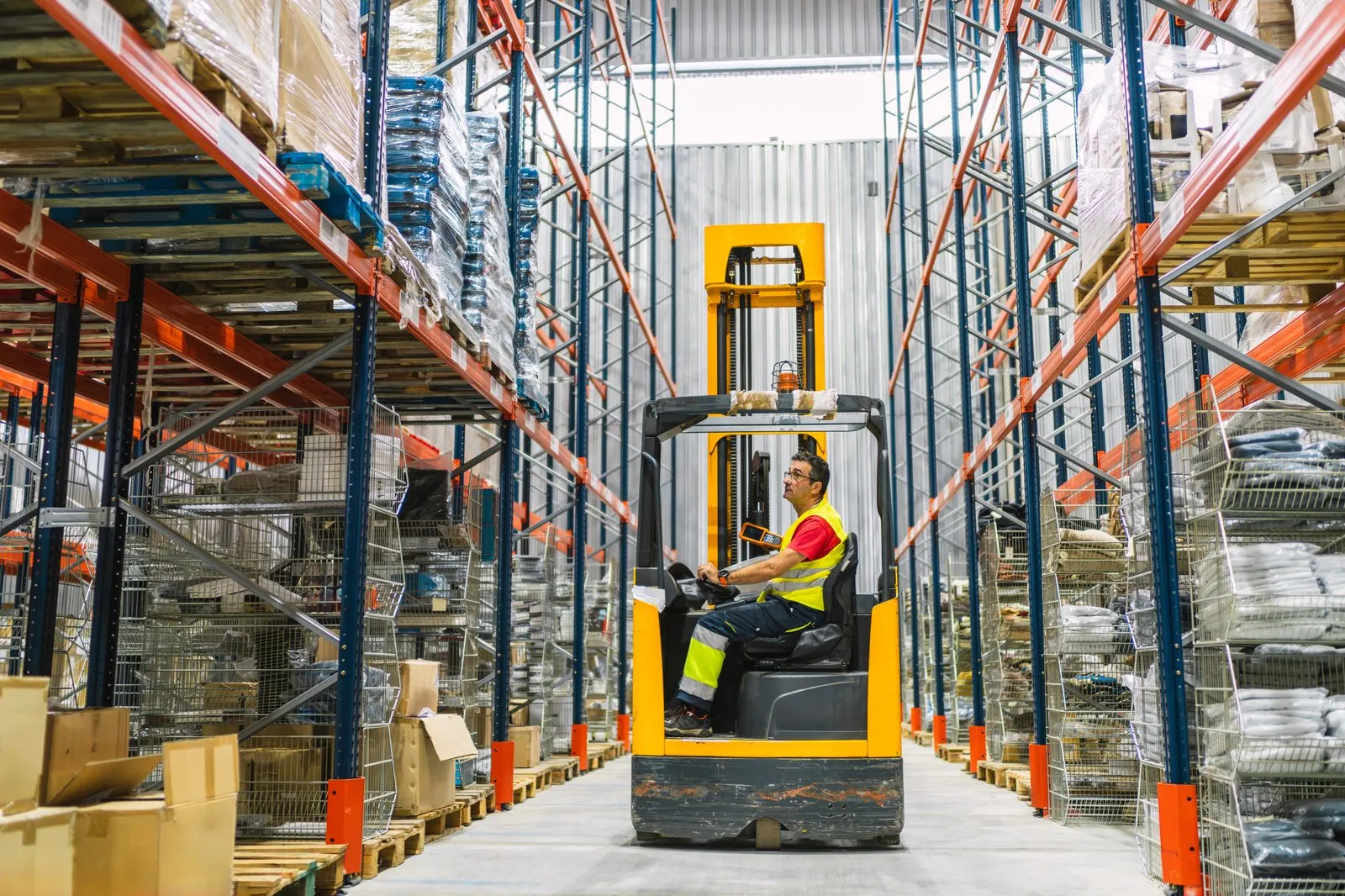
- Supervisors cannot watch every aisle. High bay aisles and dock-adjacent racking are often out of direct line of sight.
For more on dock-side risk, see our guide to loading dock safety for forklifts, trucks and pedestrians. For aisle separation, read warehouse traffic management and forklift pedestrian separation.
The solution: how Flagman protects people near racking
Flagman is AI vision that runs on site, at the edge, with no cloud or internet connection needed. It works with ONVIF IP, USB and GMSL cameras, so many warehouses can start with cameras they already have over aisles and docks.
- Pedestrian exclusion zone alerts. Define the base of a racking run, a dock-adjacent bay or a reach truck aisle as a zone. When a person is detected in that zone while a forklift or vehicle is present, Flagman raises an alert at the point of risk through lights, sirens or relay outputs.
- Forklift pedestrian detection. In a typical forklift setup, Flagman gives a warning at about 2.5 metres and a critical alert at about 1.5 metres. It can send a slow or stop signal where the machine’s controls allow, mainly on electric forklifts that accept an external signal.
- Reversing areas. A zone over the reversing path can alert a traffic controller or nearby workers when someone is behind the vehicle.
- Time-stamped video events. Every alert is logged with video on a central dashboard. Supervisors can review close calls in a racking aisle and, when damage is found, look back at vehicle activity around that bay to support the report and the inspection.
Limitations: what Flagman cannot do
- Flagman does not measure racking damage, beam deflection or load weight. It is not a racking inspection and does not replace a competent person working to AS 4084.2.
- It does not replace physical controls. Upright protectors, end-of-rack protectors, bollards, barriers, drive-through layouts and safe working load signs remain the higher order controls.
- Flagman has no published Safety Integrity Level or Performance Level rating. It is not a certified presence sensing safeguarding device.
- Detection depends on camera coverage. Tall racking, stacked stock and poor lighting create blind spots, so camera placement must be planned aisle by aisle.
- Automatic slow or stop only works on vehicles that accept an external signal. Most road trucks at a dock do not, so alerts there rely on people responding.
- In New South Wales, camera surveillance of workers falls under the Workplace Surveillance Act 2005. Give at least 14 days’ written notice, keep cameras visible, display signs and consult workers before go-live.
Predictive maintenance: plant condition is part of the hazard
Racking strikes are not only a behaviour problem. Forklift condition plays a part. Worn brakes, steering faults, mast or hydraulic problems and damaged forks make a clean approach to a bay harder. SafeWork NSW expects pre-start checks every shift, faulty forklifts removed from service and servicing by a competent person.
Treat racking the same way. Damage tags, inspection findings and repairs are condition data. When that data is trended, it shows which bays are struck repeatedly, which aisles are too tight for the trucks in use and where protectors need upgrading. Linking it to forklift service records, breakdowns and Flagman close-call events shows whether a high-risk aisle is a layout, equipment or behaviour problem.
Sharktech Global builds Business Intelligence dashboards that bring maintenance, downtime and safety data together, including Flagman events, so managers see one picture rather than three spreadsheets.
A practical plan for racking aisles
- Map the risk. Walk the site and mark every place where racking, reversing vehicles and people meet. Start with dock-adjacent bays and reach truck aisles.
- Fix the physical controls first. Check upright and end-of-rack protectors, load signs, aisle widths and whether drive-through access can reduce reversing.
- Update the traffic management plan. Set exclusion zones, right-of-way rules and when traffic controllers are required.
- Make damage reporting easy. Use tags, a simple report path and no-blame follow-up. Book the competent person inspection at least every 12 months.
- Deploy Flagman on the highest-risk zones. Pilot two or three aisles or a dock, tune alert distances with operators and record a baseline.
- Review weekly. Look at close-call events, damage reports and forklift faults together, then adjust zones, layout or training.
The outcome you can measure
- Alerts at the point of risk when people are in racking aisles or reversing zones with vehicles present.
- Close calls captured as time-stamped events instead of going unreported.
- A before and after comparison of exclusion zone breaches against your pilot baseline.
- Evidence for your traffic management plan, racking inspections and conversations with SafeWork NSW inspectors.
Flagman in Australia: local delivery by Sharktech Global
Sharktech Global, based in Liverpool, New South Wales, is the exclusive Australian and New Zealand delivery partner for Perleybrook Labs. Sharktech Global assesses sites, installs and integrates Flagman with existing cameras and controls, and provides local business-hours support. Learn more about Sharktech Global’s warehouse technology services.
Key takeaways
- Pallet racking safety depends on keeping people clear when vehicles operate near loaded racks.
- SafeWork NSW expects separation, collision protection, load signs, damage reporting and competent inspections, and forklifts are a 2026 to 2027 priority.
- Flagman adds exclusion zone alerts, forklift pedestrian detection and video evidence. It does not inspect racking or replace physical controls.
- Trend racking damage, forklift faults and close calls together to find the aisles that need change.
Next step
Request a Flagman safety assessment or call Sharktech Global on 0468 017 373.
Sources: SafeWork NSW, Worker fatally injured by falling objects (2 October 2024); SafeWork NSW, Pallet racking guide; SafeWork NSW, Forklifts; SafeWork NSW, NSW Forklift Safety Report (February 2023); Safe Work Australia, Key Work Health and Safety Statistics Australia 2025. This article is general information only and is not legal advice. Seek advice specific to your site and jurisdiction.