Glass and Stone Slabs Fall Without Warning: How Flagman Keeps Workers Out of the Fall Zone in NSW Fabrication Shops
Glass handling safety in NSW: SafeWork NSW incidents show how glass panels and stone slabs fall. See how Flagman detects people in fall zones during lifts and unloading.
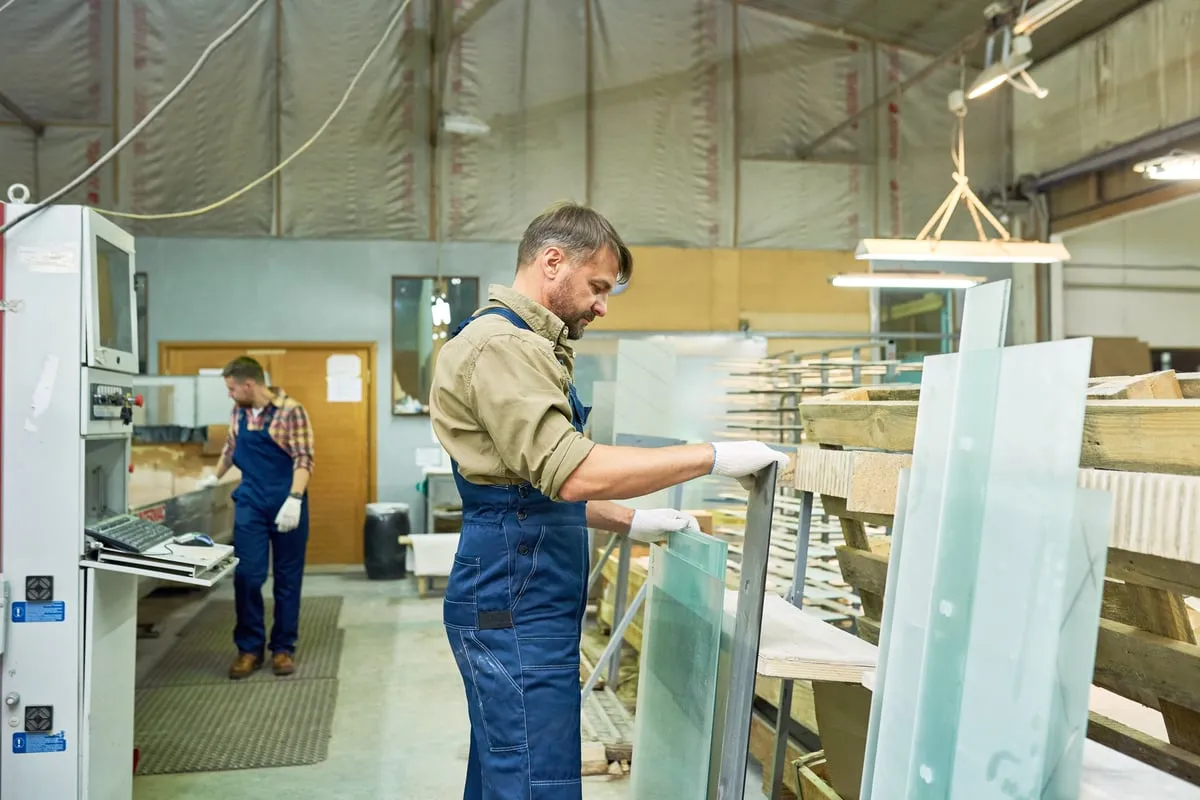
In brief
- Glass panels and stone slabs stored on edge can fall without warning, and SafeWork NSW has reported serious and fatal crush injuries during unloading, storage and handling.
- SafeWork NSW expects purpose-designed racking, restraints, lifting aids and enforced exclusion zones that keep workers out of the fall zone.
- Flagman AI vision can watch defined fall zones around racks, frames and unloading bays, alert when a person enters during a lift, and record each event as evidence.
- The outcome is a measurable record of how often people step into the fall zone, so supervisors can fix the task design before someone is trapped.
The job looks routine. A gantry crane operator lifts an offcut from a post frame rack while a second worker guides the grab. A delivery of glass panels arrives on a flatbed and the crew starts unloading by hand. Nobody thinks of these as high risk tasks, because they are done every day.
Then a strap is released a moment too early, or someone stands on the wrong side of a post, and hundreds of kilograms of sheet material moves at once. There is no time to step away. In glass and stone fabrication, the control that matters most is simple to state and hard to sustain: nobody stands in the fall zone.
The problem: sheet materials that fall without warning
SafeWork NSW has published two incident information releases that show the pattern. In November 2021, a 29-year-old worker at a Kogarah factory was positioning a gantry crane grab onto stone stored on post frame racking. He was standing in front of the stone when approximately nine slabs fell, trapping him from the waist down with pelvic and leg fractures and serious internal injuries.
In 2026, SafeWork NSW reported two more glass incidents. On 11 March, a worker entered a shipping container and removed a restraint strap on a pallet of upright glass panels while the load was being prepared for a mobile crane lift. The pallet collapsed and the worker suffered serious crush injuries. On 20 April, panels with a combined estimated weight of about 300 kilograms fell from a flatbed truck during manual unloading. The worker standing on the ground beside the truck was fatally injured.
Safe Work Australia’s Key Work Health and Safety Statistics 2025 report 7 manufacturing worker fatalities in 2024 and 14,800 serious manufacturing claims in 2023 to 2024. Glass processors, stone fabricators and window makers all handle sheet materials stored on edge.
The requirement: what SafeWork NSW expects
Under the Work Health and Safety Act 2011 (NSW), a person conducting a business or undertaking must manage risks so far as is reasonably practicable. For sheet materials, SafeWork NSW sets out clear expectations in its incident releases:
- Store slabs and sheets on A-frames, truss or post frame racking or other purpose-designed systems, within the safe load limit, and restrain them against later movement.
- Reposition post frame posts progressively as material is removed.
- Keep panels restrained and stable at all times, including when restraints are loosened before unloading.
- Establish and enforce exclusion zones so workers stay clear of unsecured or suspended glass, and never stand in front of, beneath or beside unstable panels.
- Never stand between the sheets and the posts.
- Use mechanical lifting aids and plant designed for the lift, with suitable lifting attachments.
The SafeWork NSW Code of Practice for managing the risks of plant in the workplace also applies to the cranes, forklifts and lifting attachments used for these tasks, including inspection and maintenance.
Why existing controls leave a gap
Racking, restraints and lifting equipment are the right controls, and they must come first. The gap is the exclusion zone. It is usually an administrative control: a painted line, a procedure, a toolbox talk and a supervisor who cannot watch every lift.
In each incident above, a worker was positioned near the load at the moment it moved. Under production pressure, stepping into the fall zone to guide a grab, cut a strap or steady a panel feels efficient. Most of those moments end without harm, so they are never reported. The site has no data on how often the exclusion zone is breached until the day a load falls.
The solution: how Flagman watches the fall zone
Flagman is an AI vision system that runs on site, on edge hardware, using new or existing IP cameras. For sheet material handling, it can be configured to:
- Define fall zones as detection zones. Zones can be drawn in front of A-frames and post frame racks, beside truck unloading bays and around container doors, matched to the height and angle of the stored material.
- Alert when a person enters during a lift. Flagman detects people in the zone and triggers a local warning, such as a light or siren, so the crane operator and the worker both know the zone is occupied.
- Link to crane and plant controls. Through relay outputs or PLC integration over Modbus or PROFINET, Flagman can send a slow or stop signal where the overhead crane or plant controls allow. This supports, and never replaces, the crane’s own safety systems.
- Watch forklift and pedestrian interaction. At goods-in bays, Flagman’s forklift setup can give a warning at about 2.5 metres and a critical alert at about 1.5 metres.
- Check PPE at the work area. PPE detection can flag missing required items at the handling station.
- Record every event. Each alert is time-stamped with video and logged to a central dashboard, giving supervisors near miss data they rarely capture today.
The same approach applies to suspended loads more broadly. Our guide to crane and suspended load exclusion zones covers overhead crane set-up, and our post on unpacking shipping containers safely covers falling loads at the container door.
Limitations: what Flagman cannot do
- Flagman cannot tell whether a restraint is loose, a post is out of position or a slab is about to topple. It detects people in zones, not load stability.
- It does not replace purpose-designed racking, restraints, rated lifting gear or a safe system of work. It is not a certified safety function and has no published Performance Level rating.
- Cameras need a clear line of sight. Inside containers, between tightly packed racks or behind a truck, coverage may be limited and extra cameras may be needed.
- Some tasks require a worker near the load. Those tasks must be redesigned with lifting aids and tools that keep people out of the fall zone, rather than relying on an alert.
- Camera monitoring in NSW is subject to the Workplace Surveillance Act 2005, including written notice, visible cameras and signage. Consult workers before deployment.
Predictive maintenance: plant and racking condition is part of the hazard
Many sheet material incidents begin with equipment condition. A damaged A-frame, a bent post, a worn strap, a vacuum lifter losing grip or a gantry crane grab with worn jaws can turn a routine lift into a falling load. Inspection records often sit in separate spreadsheets, logbooks and maintenance systems.
A predictive maintenance approach uses inspection results, fault history and equipment run data to identify which racks, cranes and lifters need attention before they fail. Sharktech Global builds Business Intelligence dashboards that bring maintenance, downtime and safety data together, including Flagman events. A plant manager can then see, on one screen, whether fall zone alerts cluster around a rack that is overdue for inspection or a crane with repeat faults.
A practical plan for glass and stone handling areas
- List every location where sheet materials are stored on edge, lifted or unloaded, including goods-in bays and container areas.
- Confirm racking type, safe load limits, restraints and post positioning for each location.
- Review each lifting task with workers. Identify every step where a person currently stands near the load, and redesign it with lifting aids or remote tools.
- Mark fall zones physically, then configure matching Flagman detection zones.
- Agree the alert response: who stops, who checks, and when the lift can resume.
- Give written notice under the Workplace Surveillance Act 2005 and consult workers on camera placement.
- Review Flagman events weekly alongside maintenance and inspection records.
The outcome you can measure
- Alerts at the point of risk when a person enters a fall zone during a lift.
- A baseline count of fall zone entries by area, shift and task, compared month on month.
- Video evidence for toolbox talks, task redesign and investigations, plus a combined view of safety events and equipment condition.
Key takeaways
- Glass panels and stone slabs stored on edge can cause fatal crush injuries in seconds.
- SafeWork NSW expects racking, restraints, lifting aids and enforced exclusion zones.
- Flagman detects people in fall zones, alerts in real time and records the evidence, while physical controls stay first.
Flagman in Australia: local delivery by Sharktech Global
Sharktech Global, based in Liverpool, New South Wales, is the exclusive Australian and New Zealand delivery partner for Perleybrook Labs. Sharktech Global assesses sites, installs and integrates Flagman with existing cameras, cranes and plant controls, and provides local business-hours support. Learn more about Sharktech Global’s manufacturing technology services.
Next step
Request a Flagman safety assessment or call Sharktech Global on 0468 017 373. We will map your glass and stone handling areas and show where fall zone detection fits alongside your existing controls.
Sources: SafeWork NSW, Serious injuries involving falling glass panels (20 April 2026); SafeWork NSW, Worker crushed by stone slabs (5 November 2021); Safe Work Australia, Key Work Health and Safety Statistics Australia 2025; SafeWork NSW, Code of Practice: Managing the risks of plant in the workplace. This article is general information only and is not legal advice. Seek advice specific to your site.