Forklifts, Walkie Stackers and Roll-Aways Keep Injuring NSW Warehouse Workers: Deploying Flagman the Way SafeWork NSW Recommends
Recent SafeWork NSW incidents involve forklifts, walkie stackers and roll-aways. How to enforce pedestrian exclusion zones with Flagman, guided by SafeWork NSW’s 2026 technology review.
In brief
- The problem: NSW warehouse workers are still being crushed and struck by forklifts and walkie stackers. In July 2025 a 26 year old operator was killed by a forklift that rolled down a driveway incline.
- The requirement: SafeWork NSW expects traffic management plans, physical separation of people and forklifts, safe parking systems and recorded inspection and maintenance of brakes and controls.
- The new guidance: SafeWork NSW’s May 2026 review of safety technologies for mobile plant sets out what proximity detection and AI cameras can and cannot do, and how to adopt them well.
- The outcome: Flagman forklift pedestrian detection, deployed the way the review recommends, enforces pedestrian exclusion zones and produces evidence that separation is working.
A distribution centre in Wetherill Park is approaching peak season. More stock, more casual staff, more forklifts and walkie stackers in the same aisles. The traffic management plan is laminated on the wall. The question every warehouse manager should ask is whether the floor still matches the plan at 2 am on a Friday.
Three recent SafeWork NSW incident releases show what happens when it does not. This article uses those incidents and SafeWork NSW’s own research on safety technology to show where Flagman can make a practical difference, and where it cannot.
The problem: what recent NSW warehouse incidents show
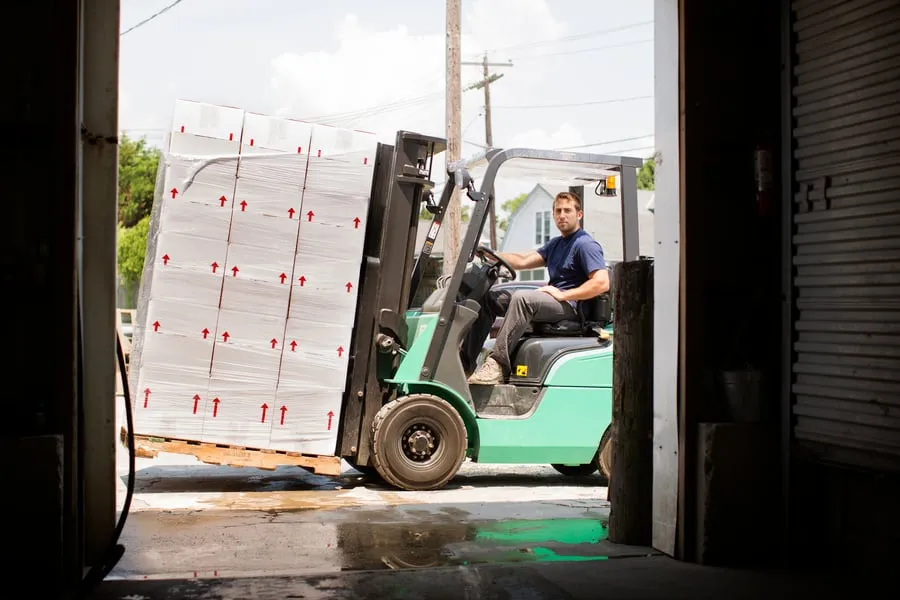
- Roll-away forklift, 25 July 2025: a 26 year old operator parked a forklift on a gradual driveway incline and walked to the bottom to check boxes. The forklift rolled, struck the operator and caused fatal injuries.
- Walkie stacker fall, 21 October 2025: a worker was raised about 3.5 metres on a walkie stacker to trim branches. The stacker tipped and the worker was seriously injured.
- Walkie reach stacker crush, 19 April 2026: while reversing and turning a walkie reach stacker after setting down a pallet, a warehouse worker’s boot became trapped under the machine’s skirt, causing a crush injury.
The wider data is just as clear. SafeWork NSW reports that 571 NSW worker fatalities between 2003 and 2023 involved a vehicle incident. Unsafe operation of moving plant, vehicles and fixed machinery accounted for 285 of the 506 notices issued in SafeWork NSW’s July 2025 statewide inspection blitz.
The requirement: what SafeWork NSW expects
Across these incident releases, SafeWork NSW recommends:
- A traffic management plan that separates pedestrians from mobile plant, with barriers or guard rails where practicable.
- Dedicated forklift parking locations so forklifts are not parked on inclines.
- Inspection and maintenance of forklifts, including service and parking brakes, by a competent person, with records.
- Pre-operation checks, operator training on the specific model and a valid high risk work licence (class LF) for forklift operators.
- Plant designed for working at height, never a person raised on a stacker or forklift without an approved platform.
For a full traffic plan structure, see our guide to forklift pedestrian injuries in distribution centres.
What SafeWork NSW’s technology review says
In May 2026 SafeWork NSW published Technologies for mobile plant, a review of emerging technologies that keep people and plant apart. It does not endorse any product, but its findings are a useful buying and deployment guide:
- Camera-based AI can create a virtual fence around danger zones, detect people in forklift blind spots and, in some cases, work with existing CCTV.
- Limitations are real: performance can drop in poor lighting or obscured views, and frequent alerts risk alarm fatigue.
- Adoption advice: consult workers and health and safety representatives, trial before rollout, prioritise the highest-risk tasks, use technology to augment rather than replace existing controls, maintain and calibrate systems, and be transparent about what data is collected and how it is used.
Where Flagman can make a difference
Matched against the incidents and the review, Flagman adds value where people and plant share space:
- Forklift pedestrian detection: Flagman detects people, not tags, near forklifts, reach trucks and walkie stackers. A typical setup gives a warning at about 2.5 metres and a critical alert at about 1.5 metres, tuned to each aisle to limit nuisance alerts.
- Pedestrian exclusion zones that enforce themselves: virtual zones on ramps, driveways, loading docks and aisle ends alert when a person enters while plant is present, including the area below ramps and inclines where parked plant could roll.
- Slow or stop where controls allow: relay and programmable logic controller outputs can send a signal to forklifts, doors or conveyors that accept an external input, mainly electric forklifts.
- Works with existing cameras: Flagman supports ONVIF IP, USB and GMSL cameras, so some warehouses can extend existing CCTV.
- Privacy by design: video is processed on site by the Flagman Neo edge device. The default Australian setup detects people, vehicles and PPE without facial recognition.
- Evidence: every detection is logged with time-stamped video, showing where separation is failing.
Limitations: where Flagman will not help
Flagman cannot stop a forklift that is rolling with no one at the controls, and it does not replace parking brakes, wheel chocks or safe parking systems. It will not prevent an operator’s foot being caught under their own walkie stacker, where machine design, training and footwear are the primary controls. It does not make it safe to raise a person on a stacker. It does not replace barriers, traffic management plans or licensing, and it has no published safety integrity level or performance level rating. Cameras need line of sight and suitable lighting, including in cold stores and night shifts.
Maintenance is a safety control: the case for predictive maintenance
SafeWork NSW’s roll-away recommendations start with brakes, inspections and records. In most warehouses, forklift maintenance is still reactive or calendar-based, and pre-operation check sheets are filed rather than analysed. A predictive approach treats every pre-start defect, brake adjustment and repair as data, so fleets that are drifting towards failure are found before they cause harm.
Sharktech Global builds Business Intelligence dashboards for warehouses that connect warehouse management, enterprise resource planning and operational data, and can add Flagman safety events. Seeing recurring brake defects and rising pedestrian alerts on the same forklift is the kind of signal that turns maintenance into prevention.
A practical plan for NSW warehouses
- Walk the floor at peak times and on night shift, and compare it with the traffic management plan.
- Mark no-parking zones on every ramp and incline, and fix parking procedures.
- Move forklift pre-start checks to a digital record and review defects weekly.
- Consult workers and health and safety representatives before introducing any detection technology.
- Trial Flagman in the highest-risk zone, such as a dock or ramp, with agreed measures.
- Tune alert zones to reduce nuisance alerts, then review results before wider rollout.
Flagman in Australia: local delivery by Sharktech Global
Sharktech Global, based in Liverpool, New South Wales, is the exclusive Australian and New Zealand delivery partner for Perleybrook Labs, the developer of Flagman. It assesses warehouses, installs and integrates Flagman with cameras and plant controls, and provides local support, alongside managed IT for scanners, label printers and rugged tablets. Details of its warehouse safety, managed IT and data services are on the Sharktech website.
The outcome you can measure
- Alerts to pedestrians and operators at the point of risk.
- Pedestrian exclusion zone breaches counted by zone, shift and vehicle.
- Forklift defects and safety events visible together for earlier maintenance decisions.
- Evidence of consultation, trial and verification that aligns with SafeWork NSW’s guidance.
Key takeaways
- Recent NSW incidents involve forklifts, walkie stackers and roll-aways, not just collisions.
- SafeWork NSW expects separation, safe parking and recorded maintenance first.
- Its 2026 technology review supports AI detection as an added layer, introduced with consultation and trials.
- Flagman enforces exclusion zones and records breaches; maintenance data keeps the fleet safe.
Next step
Request a Flagman safety assessment for your warehouse, or call Sharktech Global on 0468 017 373.
See also: Choosing a Pedestrian Detection System: An Australian Scorecard.
Sources: SafeWork NSW, incident information releases (roll-away forklift, July 2025; walkie stacker fall, October 2025; walkie reach stacker crush, April 2026); SafeWork NSW, Technologies for mobile plant (May 2026); NSW Government, SafeWork NSW statewide blitz (July 2025); Safe Work Australia, Traffic Management: Guide for Warehousing. This article is general information only and is not legal advice.